


Artwork guide
What is a vector file?
A vector file stores your logo as lines and shapes described by maths, not as a grid of pixels, so it stays sharp at any size. PDF, AI, EPS and SVG files can all hold vectors. It's the best artwork you can send for screen printing, but if you haven't got one, send what you have: we check every file for free.
7 min read · Updated 24 September 2026
Vector and pixel files: the difference
There are two ways to store a picture on a computer.
- Pixel files (also called raster or bitmap files) are a grid of tiny coloured squares. Photos are pixel files, and so are most PNG and JPG logos. Blow one up and the squares show: curves go jagged and edges go soft.
- Vector files store the outline of every shape as points joined by curves. The computer redraws them at whatever size you need, so a vector logo is as crisp on a banner as on a business card.
Why it matters for screen printing
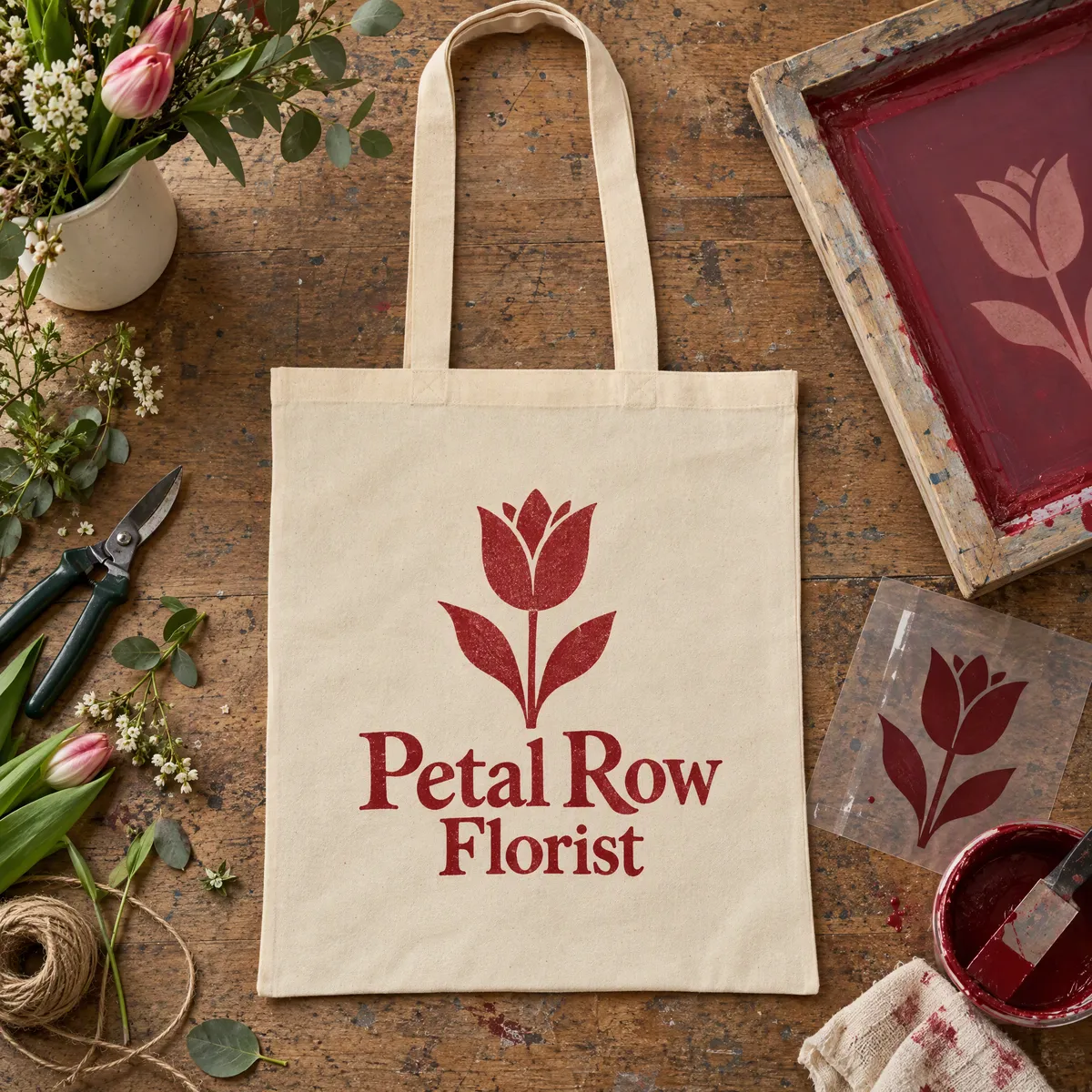
Screen printing uses a separate stencil, called a screen, for each ink colour. To make the screens, we separate your design into its colours and output each one at full print size. A vector file gives us clean, sharp edges and each colour as its own shape, so the print on the bag is as crisp as the logo on your screen.
A small pixel file can still print well if the logo is simple and the file is large enough. But a 200-pixel logo saved from a website will look soft and stepped when it's stretched to 25cm across a bag. There's more on the process in how screen printing works.
The file type isn't proof
A PDF or EPS can hold a vector logo, but it can just as easily hold a pixel image pasted in. The same goes for SVG. What counts is how the logo was made, not what it was saved as.
Common file types for logos
| Format | Vector or pixels? | For printing on bags |
|---|---|---|
| AI (Adobe Illustrator) | Vector | Ideal. This is the file most designers work in. |
| EPS | Usually vector | Very good. An older format, but still widely used for logos. |
| Either | Very good when it comes from design software with the vectors kept. | |
| SVG | Usually vector | Good. Common from web designers and Canva Pro. |
| PNG | Pixels | Fine for simple logos if it's high resolution, ideally with a transparent background. |
| JPG | Pixels | Fine for simple logos if it's high resolution. No transparency, and edges can show blocky marks. |
| Word, PowerPoint or a screenshot | Usually low-resolution pixels | Send the original logo file instead if you can find it. |
How to tell if your logo is a vector
Try these quick checks:
- The zoom test. Open the file and zoom right in, to 800% or more. If the edges stay smooth and sharp, it's vector. If you see squares or fuzz, it's pixels.
- The select test. Open a PDF in a PDF viewer and try to highlight the words in the logo. If you can select the letters as text, that part is vector. (If you can't, it may still be vector with the text outlined, so try the zoom test too.)
- Check the folder. Brand packs from a designer often have folders labelled print and web. The print files, usually PDF, AI or EPS, are the vectors.
If a file says 300dpi, it's a pixel file. That's a good resolution for a pixel file, but it isn't a vector.
Exporting print artwork from Canva
Lots of people design their logos and bags in Canva. Here's how to get the best print file out of it.
Check what your logo is made of
Canva text, shapes and lines can come out as vectors. Photos, and any PNG or JPG logo you uploaded, stay as pixels whatever format you download. Putting a pixel logo into Canva doesn't turn it into a vector.
Keep the colours flat
Use solid colours only, with no gradients, shadows or see-through effects, and only as many colours as you plan to print. Delete any background colour so we can see exactly where the ink goes.
Download as PDF Print
Open the download options (under Share in Canva) and choose PDF Print. If you see an option to flatten the PDF, leave it off: flattening can turn the whole design into a single image.
Or download an SVG
If you have Canva Pro, SVG is also a vector format. The same rule applies: only the vector parts of your design come out as vectors.
Send it to us
Upload the file with your order or to our free artwork check. We'll tell you if anything won't print well, and email a proof before we print.
A few more Canva points
- Transparent PNGs need Canva Pro. On the free plan, a PNG download has a background. A PDF Print is the better choice for printing anyway.
- You don't need CMYK. Screen printing doesn't use CMYK. We mix each ink to match your file, or to Pantone references if you give them, so there's no need to change colour settings. Our guide to Pantone and spot colours explains more.
- Canva's menus change from time to time. If you can't find an option we've mentioned, download the best PDF you can and send it over. We'll tell you if it works.
No vector file? Your options
Ask whoever made the logo
The designer who created it should have the vector file. If you've had signs, vans or business cards printed, that printer probably has one too. Ask for the logo as a PDF, AI or EPS with the text outlined.
Send the biggest pixel file you have
For a simple logo, a high-resolution PNG or JPG often works well. As a rule of thumb, the file should be at least as large as the print, at a good resolution. A PNG with a transparent background is best.
Trace it
Design programs can trace a pixel logo into vector shapes: Image Trace in Adobe Illustrator, or Trace Bitmap in the free program Inkscape. Auto-tracing works best on bold, simple logos from a sharp, large image. It can't add detail that isn't there, so check the curves and lettering closely afterwards.
Let us check it
Send it to our free artwork check. We'll look at it and tell you honestly whether it will print well on a bag.
Before you send your artwork
- A vector file if you have one: PDF, AI or EPS. High-resolution PNG or JPG files work for simple logos.
- Text converted to outlines, or fonts embedded, so the lettering can't change.
- Solid colours only, with no gradients or drop shadows. We print 1 to 4 flat spot colours.
- Pantone references if your colours must match exactly. If you only have hex or CMYK values, send those and we'll match to your file.
- Nothing too fine. Very thin lines and tiny text can fill in or break up on fabric, so we'll flag them on your proof.
- Printing on a black or coloured bag? Read our guide to printing on dark bags.
Questions people ask
Is a PDF a vector file?
It can be. A PDF exported from design software such as Illustrator, Affinity or Canva (as PDF Print) usually keeps its vectors. A PDF made by scanning, or from a pasted-in picture, is just pixels inside a PDF. The zoom test will tell you.
Is a PNG a vector file?
No. PNG and JPG are pixel formats. A large, sharp PNG can still print well for a simple logo, but it can't be scaled up without losing quality.
Can Canva make a vector file?
Partly. When you download a PDF Print, or an SVG with Canva Pro, Canva's own text, shapes and lines come out as vectors. Photos and uploaded pixel images stay as pixels.
How do I turn a JPG into a vector?
You can trace it with Image Trace in Adobe Illustrator or Trace Bitmap in the free program Inkscape. It works best on bold, simple logos. For anything detailed, ask the original designer for the vector file.
Do I need a vector file to order?
No. Vector files give the best result, but high-resolution PNG or JPG files work for simple logos. We check every file for free and email a proof, and nothing is printed until you approve it.
What does "convert text to outlines" mean?
It turns each letter into a shape, so the file no longer needs the font. That way, your lettering prints exactly as you designed it, even if we don't have your font.
Not sure your file will print?
Send it to us. We'll check it for free and tell you straight away.