
Print guide
Bag print methods compared
For a logo in 1 to 4 colours across a run of bags, screen printing gives a hard-wearing print and usually the lowest price per bag. DTG suits photos and one-offs, heat transfer suits individual names, and embroidery suits a small, premium logo. We only screen print, so this guide tells you honestly when another method would suit you better.
6 min read · Updated 24 September 2026
The four methods at a glance
| Screen printing | DTG | Heat transfer | Embroidery | |
|---|---|---|---|---|
| How it works | Ink is pushed through a mesh stencil, one screen per colour | An inkjet printer prints straight onto the fabric | A design cut from vinyl, or printed on film (DTF), is heat-pressed on | The design is stitched in thread by machine |
| Best for | Logos and text in 1 to 4 solid colours, the same on every bag | Photos, gradients and one-offs | Individual names or numbers | A small, premium logo on heavier fabric |
| Setup | A one-off screen charge per colour | Little or none | Little or none | Usually a one-off charge to set up the stitch file |
| Price per bag as you order more | Falls steeply | Stays much the same | Stays much the same | Falls a little. Priced by the number of stitches |
| Hard-wearing | Very, with sensible care | Good, but can fade sooner with washing | Good, but vinyl can crack or lift over time | Very |
| Colour matching | Inks mixed to your file or Pantone references | Printed from a set of process inks, so close rather than exact | Limited vinyl colours, or process inks on film | Thread colours chosen from a chart |
| Do we offer it? | Yes, in-house in Leeds | No | No | No |
These are general points about each method. Results vary between printers, fabrics and designs.
Screen printing: what we do
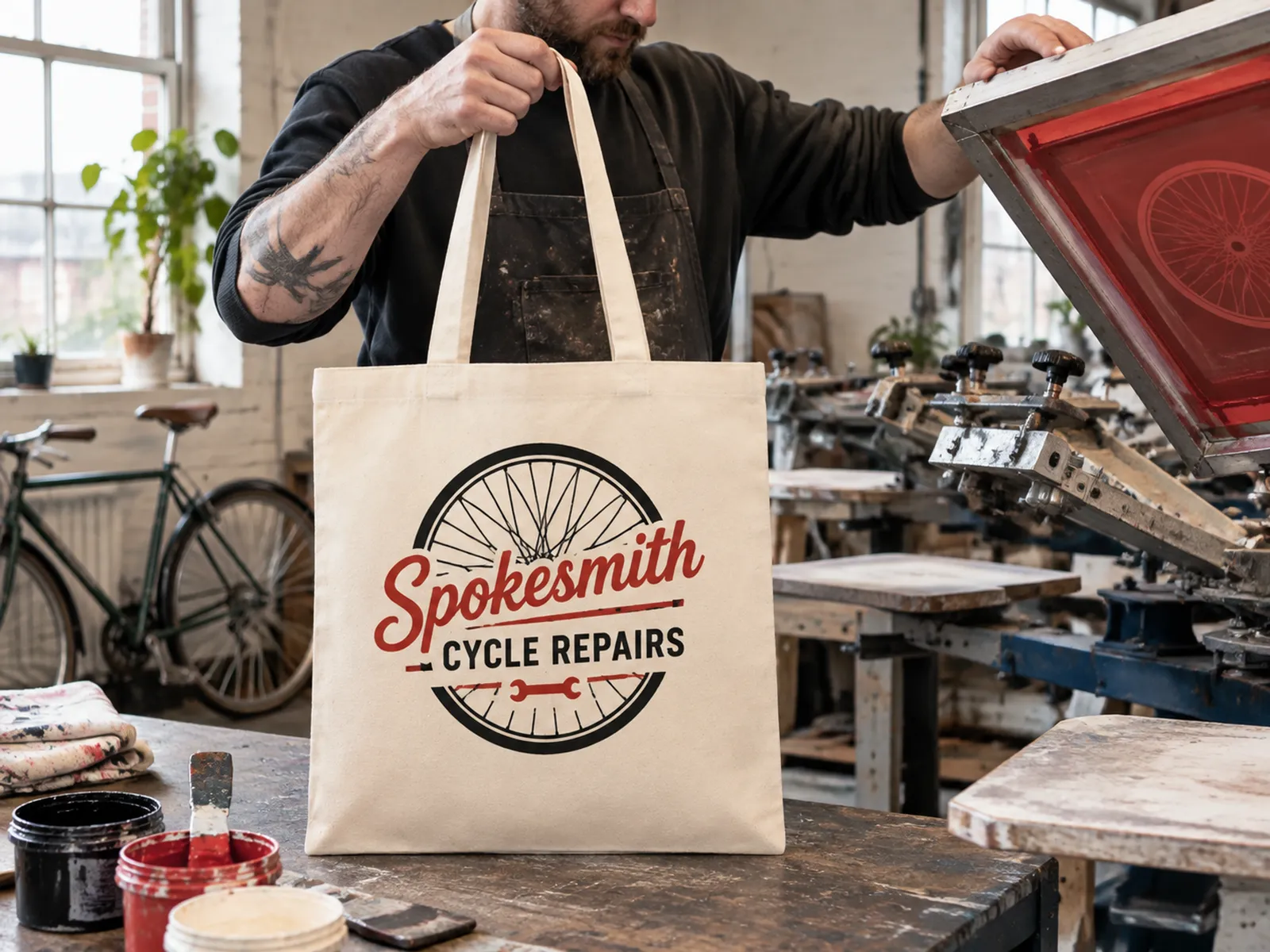
Screen printing is the traditional way to print bags, and it's still the best way to put the same logo on a run of them. We make a fine mesh screen for each ink colour, with your design open in the mesh and everything else blocked. Ink is pulled across the screen with a squeegee and pressed through onto the bag, one colour at a time. The ink is then cured with heat so it bonds to the fabric. There's more detail in how screen printing works.
Why it costs less per bag as you order more
Each colour needs its own screen, and each screen has a one-off charge. Once the screens are made, printing each extra bag costs very little. So the screen charges are spread across your whole run, and the price per bag drops as the quantity goes up. Our colour cost tool shows how it works with live prices.
Where it shines
- Solid, bright colour. Each ink is mixed to your file or to Pantone references, so brand colours come out right. See Pantone and spot colours.
- It lasts. A cured screen print sits in the weave of the fabric and survives years of use with sensible washing.
- It works on dark bags. Screen printing inks can be printed onto black and coloured bags. Our guide to printing on dark bags explains what to expect.
- Cotton, canvas, jute and polyester. We print on every bag we sell.
Where it doesn't
- Photos and soft gradients. Screen printing lays down flat spot colours, so photographic designs don't suit it.
- Individual names. Every bag in a run gets the same print, because the screens are the same.
- A handful of bags. There's no fixed minimum, but the screen charges are the same however few bags you order, so on a very small run each bag costs more. A digital method may work out better.
The other methods, and when they win
DTG (direct to garment)
DTG is an inkjet printer for fabric. It prints the design straight onto the bag, in full colour, with no screens to make. That makes it good for photos, detailed illustrations and one-off bags. The trade-offs: the price per bag stays much the same however many you order, colours are printed from a set of process inks rather than mixed to match, and prints can fade sooner with washing. DTG works best on smooth, light cotton, and less well on coarse fabrics like jute.
Heat transfer: vinyl and DTF
With heat transfer, the design is made first and then heat-pressed onto the bag. Vinyl transfers are cut from sheets of coloured film, which suits names, numbers and simple text. DTF (direct to film) prints a full-colour design onto film, which is then pressed on. Both need little setup, so they're good for small runs and for giving every bag a different name. The print is a layer on top of the fabric, and over time it can crack or lift.
Embroidery
Embroidery stitches your logo in thread. It looks premium and lasts very well. It's priced by the number of stitches, so it suits small logos rather than large designs. Heavier fabrics, such as canvas, carry embroidery better than light cotton shoppers, which can pucker around the stitching.
Sublimation
Sublimation turns ink into a gas that bonds with polyester fibres. It gives vivid, full-colour prints, but only on polyester or polyester-rich fabric in light colours. It doesn't work on cotton, canvas or jute, so it isn't an option for most tote bags.
Why we stick to screen printing
We're a family-run print works in Leeds, and screen printing is what we do. It's the right method for the bags most people order: a logo in one to four colours, on a run of bags for an event, a shop, a club or a business.
Doing one thing in-house means we know every press and every ink, and we check every file ourselves. If your design would be better done another way, we'll tell you, rather than print something you're not happy with.
Which method should you choose?
- A logo in 1 to 4 colours, the same on every bag, 25 bags or more: screen printing. See our bags.
- A photo or a design full of gradients: DTG or DTF from a digital printer. Or ask us whether it could work in two or three flat colours, which often looks bolder on a bag.
- A different name on every bag: vinyl or DTF. For weddings, schools and teams, a single design listing everyone's name can be screen printed on every bag. See our wedding tote bags.
- A handful of bags, all different: DTG or heat transfer, which have little or no setup.
- A small stitched logo for staff or uniform: embroidery, ideally on a heavier canvas bag.
Questions people ask
Is screen printing better than DTG?
For logos in a few solid colours across a run of bags, yes: screen printing gives brighter, closely matched colours, lasts well and usually costs less per bag. For photos, detailed full-colour artwork or a handful of one-offs, DTG is the better choice.
Which costs less, screen printing or embroidery?
For most bag orders, screen printing costs less per bag, especially for larger designs, because embroidery is priced by the number of stitches. Embroidery is worth it when you want a small, premium stitched logo.
Does screen printing wash off?
No. The ink is cured with heat so it bonds with the fabric. With sensible care, a screen print lasts as long as the bag. Our wash and care guide explains how to look after printed bags.
Can you print photos on tote bags?
Not with screen printing, which prints flat spot colours. A DTG or DTF printer can print photos. Many photo-style designs can be redrawn in two or three colours, and we're happy to tell you whether yours could.
Can you print a different name on each bag?
No. Screen printing puts the same print on every bag. For a wedding, school or team, one design with everyone's name on it works well and prints on every bag.
What is DTF printing?
DTF stands for direct to film. A full-colour design is printed onto a film, coated with an adhesive powder, then heat-pressed onto the fabric. It suits small runs and full-colour designs. We don't offer it.
Got a design in mind?
Send it over and we'll tell you honestly whether screen printing suits it. Every file is checked for free.